
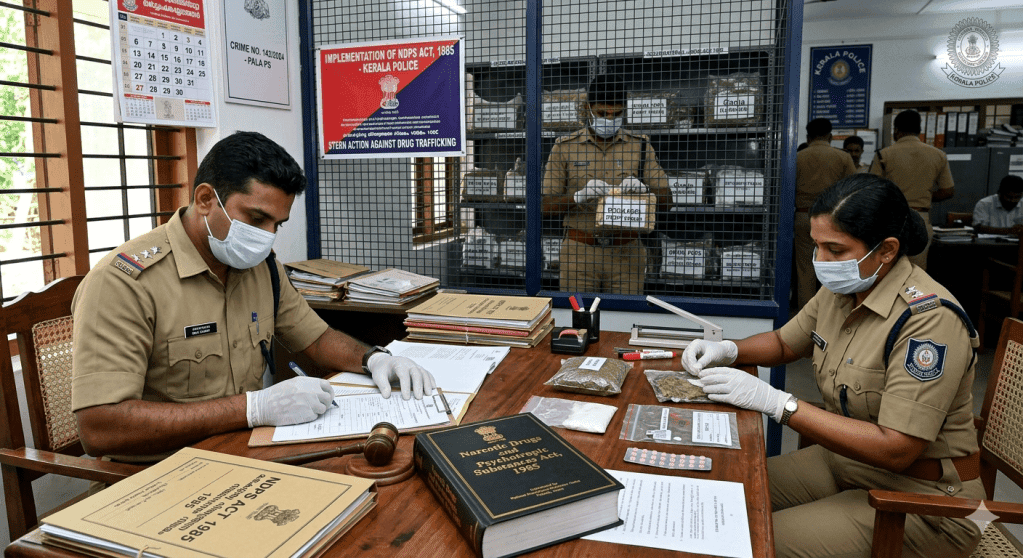

The Narcotic Drugs and Psychotropic Substances Act, 1985, commonly referred to as the NDPS Act, serves as the primary legislative instrument in India’s multi-pronged strategy to combat drug trafficking and substance abuse. This legislation was enacted during a period of significant domestic and international transition, representing a shift from a centuries-old tradition of regulated tolerance to a modern regime of strict prohibition and stringent enforcement. The legal framework established by the NDPS Act is characterized by its rigor, encompassing a wide range of activities including the cultivation, production, manufacture, possession, sale, purchase, transport, warehousing, and consumption of narcotic drugs and psychotropic substances. To understand the depth of this Act, one must examine its historical origins, the international pressures that shaped its formulation, the evolving judicial interpretations of its procedural safeguards, and the modern administrative strategies employed to realize the vision of a “Drug-Free India”.
Historical genesis and international regulatory pressures
The path toward the enactment of the NDPS Act in 1985 was neither linear nor purely domestic. For centuries, India maintained a culturally integrated relationship with substances like opium and cannabis. Cannabis derivatives, such as ganja, bhang, and charas, were not only legally sold but were common features of religious and social life. Bhang, in particular, was widely consumed during festivals like Holi, and cannabis was often viewed by the upper classes as the “poor man’s intoxicant”. Regulatory efforts during the colonial era, such as the Opium Acts of 1852 and 1878 and the Dangerous Drugs Act of 1930, focused more on revenue and supply control than on total prohibition.
The transformation began in the mid-20th century with the global move toward drug prohibition led by the United States. The adoption of the Single Convention on Narcotic Drugs in 1961 placed substantial international pressure on India to criminalize cannabis and opium. India resisted these pressures for nearly twenty-five years, arguing that total prohibition would conflict with long-standing social and religious customs. However, by the 1980s, increased pressure from the American administration, coupled with a growing domestic concern over India’s emergence as a transit country for international trafficking routes, led to the enactment of the NDPS Act by the Rajiv Gandhi government.
The Act was designed specifically to fulfill India’s treaty obligations under the Single Convention on Narcotic Drugs (1961), the Convention on Psychotropic Substances (1971), and later the United Nations Convention Against Illicit Traffic in Narcotic Drugs and Psychotropic Substances (1988). These treaties provided the skeletal structure for the Act, requiring signatory nations to limit the use of controlled substances strictly to medical and scientific purposes.
Legislative milestones and amendments
Since its implementation on November 14, 1985, the Act has been amended four times—in 1988, 2001, 2014, and 2021—reflecting the evolving nature of the drug problem and the need for more nuanced legal responses.
| Amendment Year | Key Legislative Objectives | Notable Legal Impacts |
| 1988 | Introduction of Chapter VA and the PIT-NDPS Act. | Enabled forfeiture of illegally acquired property and preventive detention. |
| 2001 | Rationalization of sentencing structure. | Categorized offenses by small, intermediate, and commercial quantities to differentiate users from traffickers. |
| 2014 | Facilitation of medical use and procedural standardization. | Introduced “Essential Narcotic Drugs” (END) and established Section 52A for drug disposal. |
| 2021 | Rectification of drafting errors. | Corrected the definition link in Section 27A to ensure validity of financing/harbouring charges. |
The 2001 amendment remains the most significant shift in philosophy, moving away from a uniform, harsh sentencing model that treated every offender as a major trafficker. Before 2001, even minor possession could lead to long mandatory prison terms, a situation that courts criticized as disproportionate. By creating quantity-based tiers, the legislature sought to balance the need for deterrence with the principles of fair and proportionate justice.
The regulatory framework: Core definitions and chemical classifications
The legal potency of the NDPS Act is rooted in its expansive and technically precise definitions. It distinguishes between substances based on their origin, chemical profile, and potential for abuse.
Narcotic drugs and psychotropic substances
Under Section 2, a “narcotic drug” includes coca leaf, cannabis (hemp), opium, poppy straw, and all manufactured drugs derived from these. The legal definition of “narcotic” under the Act is significantly broader than its medical definition; while medicine views narcotics primarily as sleep-inducing agents, the Act includes stimulants like cocaine and non-narcotics like cannabis.
Psychotropic substances are defined as any substance, natural or synthetic, or any natural material or salt included in the Schedule to the NDPS Act. These include mind-altering drugs such as LSD, Amphetamines, Barbiturates, and MDMA. The schedule is dynamic, allowing the Central Government to add or remove substances based on emerging patterns of abuse or scientific advancements.
| Substance Category | Common Examples | Legal Identification |
| Opiates | Heroin, Morphine, Codeine, Opium | Narcotic Drugs |
| Cannabis | Charas (resin), Hashish Oil, Ganja | Narcotic Drugs |
| Stimulants | Cocaine, MDMA, Amphetamines | Narcotic/Psychotropic |
| Hallucinogens | LSD, Magic Mushrooms, PCP | Psychotropic Substances |
| Precursors | Ephedrine, Pseudoephedrine | Controlled Substances |
The complex legal definition of cannabis and hemp
A significant area of contemporary legal focus is the definition of cannabis. Section 2(iii) defines “cannabis (hemp)” specifically as charas (separated resin), ganja (flowering or fruiting tops), and any mixture or drink prepared from these parts. Crucially, seeds and leaves, when not accompanied by the flowering tops, are excluded from this definition. This nuance allows for the traditional consumption of bhang (made from leaves) to remain outside the strictest prohibitions of the Act, provided it is regulated by state laws.
However, Section 2(iv) defines “cannabis plant” as any plant of the genus Cannabis. This blanket definition has created a legal paradox for the industrial hemp industry. While Section 14 permits state governments to allow the cultivation of cannabis for industrial purposes (obtaining fiber or seed) or horticultural purposes, the plant itself remains classified as a narcotic regardless of its Tetrahydrocannabinol (THC) content. As of 2026, there is a growing push for a parliamentary amendment to introduce a “retrospective proviso” that would explicitly exclude industrial hemp with less than 0.3% THC from the definition of a cannabis plant, thereby aligning Indian law with global industrial standards.
Offenses, penalties, and the quantity-based sentencing model
The NDPS Act treats drug offenses with extreme gravity, establishing a zero-tolerance approach for commercial trafficking while allowing for some discretion in cases of minor possession. The quantum of punishment is strictly tied to the quantity of the substance involved, categorized into small, intermediate, and commercial quantities.
| Drug Name | Small Quantity | Commercial Quantity |
| Heroin | 5 grams | 250 grams |
| Cocaine | 2 grams | 100 grams |
| Ganja | 1 kilogram | 20 kilograms |
| Charas | 100 grams | 1 kilogram |
| Opium | 25 grams | 2.5 kilograms |
| LSD | 0.01 grams | 0.1 grams |
| Methamphetamine | 2 grams | 50 grams |
Hierarchy of punishments
The sentencing tiers reflect the legislature’s intent to deter organized crime. Under Section 21 and related provisions, the penalties are structured as follows:
- Small Quantity: Rigorous imprisonment for up to one year, or a fine of up to ₹10,000, or both.
- Intermediate Quantity: Rigorous imprisonment for up to ten years and a fine of up to ₹1 lakh.
- Commercial Quantity: Mandatory rigorous imprisonment of not less than ten years, extendable to twenty years, and a fine of ₹1 lakh to ₹2 lakhs.
- Repeat Offenses: Under Section 31, penalties for second or subsequent convictions are enhanced to one and a half times the original term. In extreme cases involving large commercial quantities, Section 31A allows for the discretionary imposition of the death penalty.
Preparation to commit an offense attracts half the penalty of the offense itself, while attempts, abetment, and criminal conspiracy are punished with the same severity as the principal offense. Furthermore, Section 27A targets the financial infrastructure of the drug trade, prescribing 10 to 20 years of imprisonment for those who finance illicit traffic or harbor offenders.
Procedural compliance and investigative safeguards
The severity of the NDPS Act’s penalties is balanced by a set of mandatory procedural safeguards. These provisions are designed to protect individuals from arbitrary state action and to ensure the integrity of the evidence presented in court. In the specialized field of narcotics law, procedural lapses are often as decisive as the physical recovery of contraband.
Search and seizure: Sections 41, 42, and 43
The Act distinguishes between different search scenarios. Section 41 empowers Magistrates to issue warrants, while Section 42 grants authorized officers the power to enter, search, and seize without a warrant if they have “reason to believe” that an offense has occurred. A critical requirement under Section 42 is that the officer must record the grounds of their belief and information in writing and send a copy to their immediate superior within 72 hours. Failure to comply with this “mandatory” reporting requirement can derail the prosecution’s case.
Section 43 applies to searches in public places or in transit, such as vehicles on a highway. In these instances, the requirement for prior written recording of information is less stringent than in searches of private buildings, reflecting the practical need to prevent the rapid movement of contraband.
The personal search mandate of Section 50
Section 50 is the most significant safeguard for individual liberty under the Act. It provides that any person about to be searched has the right to be taken without unnecessary delay to the nearest Gazetted Officer or Magistrate. The investigating officer is legally bound to inform the suspect of this right.
Judicial rulings through 2025 and 2026 have clarified several aspects of Section 50 compliance:
- The “Third Option” Violation: The Supreme Court in State of Himachal Pradesh v. Surat Singh (2026) reaffirmed that offering a suspect the choice to be searched by the police officer themselves, in addition to a Magistrate or Gazetted Officer, is a violation of the law. Such a “third option” vitiates the search and the subsequent trial.
- Applicability to Body Searches: Section 50 applies strictly to the search of a person’s body or clothing being worn. It does not apply to the search of a vehicle or a bag carried by the person, although if both the person and the bag are searched, Section 50 must be followed for the personal search component.
- Individual Consent: Joint consent memos, where multiple accused are informed of their rights collectively, have been held by High Courts to be insufficient. Each individual must be informed and their response recorded separately.
Sampling and primary evidence: Section 52A
The procedure for handling seized contraband is governed by Section 52A and the Narcotic Drugs and Psychotropic Substances (Seizure, Storage, Sampling and Disposal) Rules, 2022. After seizure, the officer must prepare an inventory and apply to a Magistrate to certify its correctness. The samples drawn in the presence of the Magistrate are considered “primary evidence” in the trial.
In recent 2026 judgments, the Delhi High Court has emphasized that “substantial compliance” with these rules is necessary for a successful prosecution. In Manjay Kumar v. State, the Court granted bail because the prosecution failed to draw representative samples from every individual packet seized, instead creating composite samples from bunched lots. This was seen as a significant departure from Rule 10 of the 2022 Sampling Rules, casting doubt on the integrity of the FSL report.
Bail jurisprudence: The rigors of Section 37 and Article 21
One of the most daunting features of the NDPS Act for legal practitioners is the restricted bail regime. For offenses involving commercial quantities, Section 37 overrides the general provisions of criminal law. It mandates that bail can only be granted if the court is satisfied that there are reasonable grounds to believe the accused is not guilty and is unlikely to commit any further offense while on bail.
The “Twin Conditions” and judicial discretion
The satisfaction of these twin conditions is a high bar, often making the denial of bail the rule and its grant the exception. However, the Supreme Court has evolved an “intermediate approach” to ensure that Section 37 does not become an instrument of indefinite pre-trial detention, which would violate the right to life and liberty under Article 21 of the Constitution.
Factors influencing bail in 2025–2026:
- Prolonged Incarceration: Courts have held that if an accused has spent a significant period in custody (e.g., 2–3 years) and the trial is unlikely to conclude soon, the constitutional right to a speedy trial may outweigh the statutory embargo of Section 37.
- Lack of Evidence: If the only evidence against the accused is a co-accused’s disclosure statement (which is inadmissible under the Toofan Singh doctrine), the twin conditions are often deemed satisfied for the purpose of bail.
- Procedural Violations: Clear non-compliance with Sections 42 or 50 provides the “reasonable grounds” needed to justify bail at an early stage.
- Personal Conduct: Lack of criminal antecedents and a clean record during custody are essential prerequisites for satisfying the “unlikely to commit further offense” condition.
Evidentiary standards: Conscious possession and confessions
The prosecution under the NDPS Act often relies on the presumption of a “culpable mental state” under Section 35 and the presumption of guilt from possession under Section 54. These provisions shift the burden of proof to the accused, but only after the prosecution has established a “lawful recovery”.
The doctrine of conscious possession
“Conscious possession” requires more than just proximity to contraband; it requires physical control and mental awareness of the substance’s illicit nature. For instance, in the 2025 case of Saneesh Soman v. NCB, the Delhi High Court held that merely receiving a courier package without knowledge of its contents (LSD blots) did not constitute conscious possession. This requirement aligns narcotics law with constitutional principles by preventing convictions based on inadvertent or unknowing custody.
The impact of Toofan Singh on Section 67
Prior to 2021, statements recorded by NCB or other authorized officers under Section 67 were often admitted as confessions. However, the landmark Supreme Court ruling in Toofan Singh v. State of Tamil Nadu fundamentally altered this landscape. The Court held that officers empowered under the NDPS Act are “police officers” within the meaning of the Evidence Act, and thus, confessions made to them are inadmissible for conviction.
This has had profound implications:
- Conviction cannot be based solely on a retracted confession or the statement of a co-accused.
- Agencies must now corroborate such statements with “substantive pieces of evidence,” such as call records, financial transactions, or the actual recovery of contraband.
- The doctrine safeguards the right against self-incrimination under Article 20(3) and the right to privacy under Article 21.
Financial enforcement and the forfeiture of assets
The NDPS Act recognizes that drug trafficking is a profit-driven crime and incorporates Chapter VA to target the economic motives of traffickers. This chapter provides for the seizure, freezing, and forfeiture of property derived from or used in illicit traffic.
Forfeiture procedures and the PIT-NDPS Act
The forfeiture provisions apply to individuals convicted of serious drug offenses (punishable with 10 years or more), those detained under the Prevention of Illicit Traffic in Narcotic Drugs and Psychotropic Substances (PIT-NDPS) Act, and their associates or relatives.
The administrative process involves:
- Freezing Order: Issued by an authorized officer when property is suspected to be illegally acquired.
- Confirmation: The Competent Authority must confirm the order within 30 days.
- Notice and Adjudication: The affected person is given an opportunity to prove the property’s legitimate source. The burden of proof lies entirely on the individual.
- Appellate Review: Appeals can be filed with the Appellate Tribunal for Forfeited Property.
In 2025, the NCB intensified the use of these financial tools, freezing assets worth ₹96.69 crore in 70 cases. This strategy aims to dismantle drug syndicates by neutralizing their ability to reinvest profits into international trafficking networks.
Modern strategy: The mission for a “Drug-Free India”
Under the “Whole of Government” approach, India has escalated its efforts against narcotics through institutional, structural, and informational reforms. This strategy is anchored by the four-tier Narco-Coordination Centre (NCORD) mechanism, which ensures seamless collaboration between central and state agencies.
Enforcement and administrative pillars
The administrative architecture for narcotics control in 2025–2026 includes several critical components:
- Anti-Narcotics Task Force (ANTF): Each state and Union Territory now has a dedicated ANTF acting as the backbone of state-level enforcement.
- NCORD Meetings: Operational coordination is maintained through regular meetings at the state (253 held in 2025) and district (12,471 held in 2025) levels.
- NIDAAN Database: A comprehensive portal containing 9.50 lakh searchable records of arrested and convicted persons under the NDPS Act, facilitating intelligence sharing across agencies.
- MANAS Helpline (1933): A national toll-free helpline for reporting drug crimes and seeking help for addiction, which led to the registration of 110 cases by NCB and ANTF units in 2025.
| Enforcement Successes (2025 NCB Report) | Statistics |
| Total Narcotic Drugs Seized | 1,33,965 kg |
| Estimated Market Value | ₹1,980 crore |
| Total Arrests (including 25 foreigners) | 994 |
| Conviction Rate Achievement | 66.8% |
| Clandestine Labs Dismantled | 6 |
| Quantity of Drugs Destroyed | 77,773 kg |
Major operations in 2025, such as Operation Crystal Fortress (targeting high-quality methamphetamine) and Operation Ketamelon (busting darknet syndicates), highlight the shift toward tackling synthetic drugs and encrypted digital trafficking.
Impact of the new criminal laws: BNSS and BNS (2024–2026)
The implementation of the Bharatiya Nagarik Suraksha Sanhita (BNSS), Bharatiya Nyaya Sanhita (BNS), and Bharatiya Sakshya Adhiniyam (BSA) on July 1, 2024, has significantly impacted the procedural landscape of the NDPS Act.
Procedural shifts under BNSS
The BNSS has introduced several modernization efforts while also raising new concerns regarding personal liberty:
- Anticipatory Bail (Section 482): The BNSS has widened the scope of pre-arrest protection, removing the old CrPC proviso that allowed for arrest during the pendency of a bail application.
- Police Custody (Section 187): The 15-day police custody can now be taken in parts throughout the initial 40 or 60 days of the remand period. This allows investigators to re-interrogate suspects as new intelligence emerges from international drug network investigations.
- Technology and Evidence: The mandatory use of technology for summons, evidence collection, and the inclusion of forensic experts in heinous offenses aims to enhance the accountability and credibility of the investigative process.
- Community Service: For the first time, community service has been introduced as a reformative punishment for minor offenses. In 2025, some courts began applying this in NDPS cases, directing accused persons to contribute to initiatives like Swachh Bharat Abhiyan as a condition for bail.
Voluntary intoxication and the BNS (Amendment) Bill, 2026
The Bharatiya Nyaya Sanhita (Amendment) Bill, 2026, has introduced tougher stances on crimes committed under the influence of drugs. It proposes that if a heinous crime is committed while in a state of voluntary intoxication, the offender shall face enhanced punishments—potentially up to one and a half times the maximum term or natural life imprisonment for the most serious offenses. This reflects the government’s concern over the strong correlation between substance use and rising criminal behavior among the youth.
Socio-legal critique: Rehabilitation versus punishment
Despite the punitive rigor of the NDPS Act, there is a persistent debate regarding the effectiveness of incarceration for drug users. Sections 39, 64, and 64A of the Act provide mechanisms for rehabilitation and immunity from prosecution for addicts who volunteer for treatment.
The case for decriminalization of users
Scholars and public health experts have criticized the NDPS Act for the “over-criminalization” of addicts. While the law intends to target traffickers, in practice, many small-scale users remain trapped in the criminal justice system due to limited awareness and under-utilization of Section 64A.
| Model for Comparison | Core Philosophical Approach | Outcomes observed |
| Indian Model | Punitive stance for all, with voluntary treatment options. | High prison populations; deterrent effect on users is debated. |
| Portugal Model | Decriminalized possession for personal use since 2001. | Decreased drug-related deaths and lower HIV transmission. |
| Netherlands Model | Regulated access to “soft drugs” to separate markets. | Reduced exposure of youth to criminal trafficking circles. |
The Ministry of Social Justice and Empowerment has called for a more “humane” approach, emphasizing that drug users are often victims of psychosocial conditions who need de-addiction rather than jail. This is particularly relevant in regions like Punjab, where economic stagnation and proximity to international borders have exacerbated the drug problem.
Medical and scientific utilization of controlled substances
A vital but often overlooked aspect of the NDPS Act is its mandate to ensure the availability of controlled substances for medical and scientific use. India is one of the few countries that legally cultivates opium for the production of essential medicines like morphine and codeine.
Regulatory barriers to medical access
The International Narcotics Control Board (INCB) 2025 report highlights that despite sufficient global supply, there are profound disparities in access to opioid analgesics for pain management. In India, the 2014 amendment sought to address this by introducing “Essential Narcotic Drugs” (END) and removing state-level barriers to transportation and licensing. Furthermore, the New Drugs and Clinical Trials Rules, 2026, aim to reduce drug development timelines and digitize compliance for pharmaceutical manufacturers, further integrating medical research with controlled substance regulation.
Conclusion: Synthesis and future trajectories
The Narcotic Drugs and Psychotropic Substances Act, 1985, stands as one of the most comprehensive and technically demanding pieces of legislation in the Indian legal system. Its evolution from a tool of simple prohibition to a complex framework involving digital forensics, financial forfeiture, and tiered sentencing reflects the government’s unwavering commitment to a “Drug-Free India.” As of 2026, the Act is at a crossroads, balancing its historical stringency with the modernization of criminal procedures and a growing recognition of the need for reformative justice.
The key challenges ahead lie in resolving the legal paradox of industrial hemp, ensuring that procedural safeguards like Section 50 and 52A are not eroded by investigative haste, and effectively utilizing rehabilitation provisions to reduce recidivism among users. The success of the NDPS Act in the coming decades will be measured not only by seizure statistics and conviction rates but by its ability to protect public health while upholding the constitutional rights of all citizens. Through the coordination of the NCB, ANTF, and the judiciary, the legal framework continues to adapt, ensuring that the fight against narcotics remains both effective and just within the vision of a “Viksit Bharat @2047.”