

Describe one habit that brings you joy.
- Date of Hearing: April 22–23, 2026
- Forum: The Supreme Court of India
- Bench (Coram): Chief Justice of India Surya Kant, Justice B.V. Nagarathna, Justice M.M. Sundresh, Justice Ahsanuddin Amanullah, Justice Aravind Kumar, Justice Augustine George Masih, Justice Prasanna B. Varale, Justice R. Mahadevan, and Justice Joymalya Bagchi.
Executive Summary
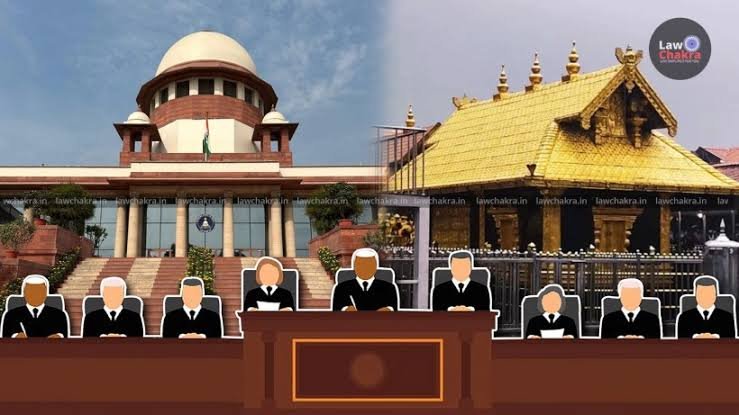
The landmark Sabarimala Reference hearing entered its eighth day of substantive oral arguments before a nine-judge Constitution Bench of the Supreme Court of India. The proceedings focused heavily on the constitutional intersection—and potential friction—between individual rights under Article 25(1) and the institutional autonomy guaranteed to religious denominations under Article 26. Senior Advocate Mr. K.K. Venugopal presented arguments emphasizing the structural limits of state intervention and the original intent of the framers of the Constitution regarding religious pluralism.
Key Submissions & Legal Arguments
1. The Dichotomy Between Individual and Institutional Rights
Counsel submitted that Article 25(1) serves as a protection for individual conscience, securing the subjective right of a person to freely profess, practice, and propagate their faith. In contrast, Article 26 confers institutional autonomy directly upon religious denominations. The defense argued that while individuals collectively establish and maintain religious institutions, those institutions must operate within the distinct doctrinal framework of the denomination to preserve the structural integrity and theological continuity of the faith.
2. Textual and Doctrinal Challenge to the “Essential Religious Practice” (ERP) Test
A significant portion of the argument challenged the judicial evolution and textual foundation of the Essential Religious Practice (ERP) test. Counsel pointed out that the restrictive qualifier “essential” is visibly absent from the text of Article 25(2)(a). The submission urged that the state’s regulatory powers under Article 25(2)(a) should be strictly confined to associated “secular activities” (financial, economic, or political administration) rather than expanding to adjudicate core theological tenets or customary beliefs.
3. Limits of State Intervention and the Doctrine of Internal Reform
Citing the Constituent Assembly debates, counsel strongly cautioned against the judiciary or the legislature acting as the primary instrument for religious reform. The arguments posited that:
- Social and religious reforms should organically emerge from within the respective religious denomination to ensure cultural legitimacy and compliance.
- Excessive or heavy-handed state intervention risks politicizing religious structures, which fundamentally compromises the secular nature of both the state and the religious institution.
- A truly secular state should maintain a posture of principled distance, refraining from day-to-day administrative interference in temples, including staffing, ecclesiastic appointments, and internal financial governance.
4. Autonomy of Ancient Traditions and Devotional Intent
Specific references were made to the broader implications on other ancient faiths, including the Parsi Zoroastrian and Jain communities, noting that long-standing traditions, sacred sites, and customary boundaries must be insulated from overarching state acquisition or structural erasure. It was emphasized that the management and expenditure of denominational trust funds must strictly mirror the documented scriptural mandates and the explicit intent of the religious devotees.
Judicial Observations
The nine-judge Bench noted the profound civilizational and systemic gravity of the reference, acknowledging that its eventual ruling will permanently govern the interpretation of constitutional morality and religious freedom for over 1.5 billion people.
The Court reiterated that these reference proceedings operate uniquely from standard adversarial litigation. Rather, they are in the nature of a macro-level “constitutional seminar” designed to settle foundational, long-standing questions of law affecting multiple faiths—including gender-exclusion boundaries, excommunication customs, and mosque access rights.
Conclusion of Day 8
The day’s arguments sharply underscored a central constitutional tension: whether legitimate secular state goals (such as public order, morality, and health) can be balanced without hollowing out the structural autonomy of religious denominations. The Bench continues to examine whether the rights of a religious denomination under Article 26 operate independently, or if they are structurally subordinate to the individual rights and restrictions contained within Article 25.
Disclaimer: Published strictly for Legal Education, Research, and Academic Awareness. Sources: Supreme Court of India Judicial Proceedings / LiveLaw & SCC Online Reports.